Eat‑Play‑Sleep Newborn Routine: Simple 2–3 Hour Flow
Build a simple newborn routine with the Eat‑Play‑Sleep cycle: feed upon waking, diaper + brief interaction, then sleep - repeating every 2-3 hours during the day. Includes flexible sample schedules for weeks 1-4 and gentle tips for day/night habits.
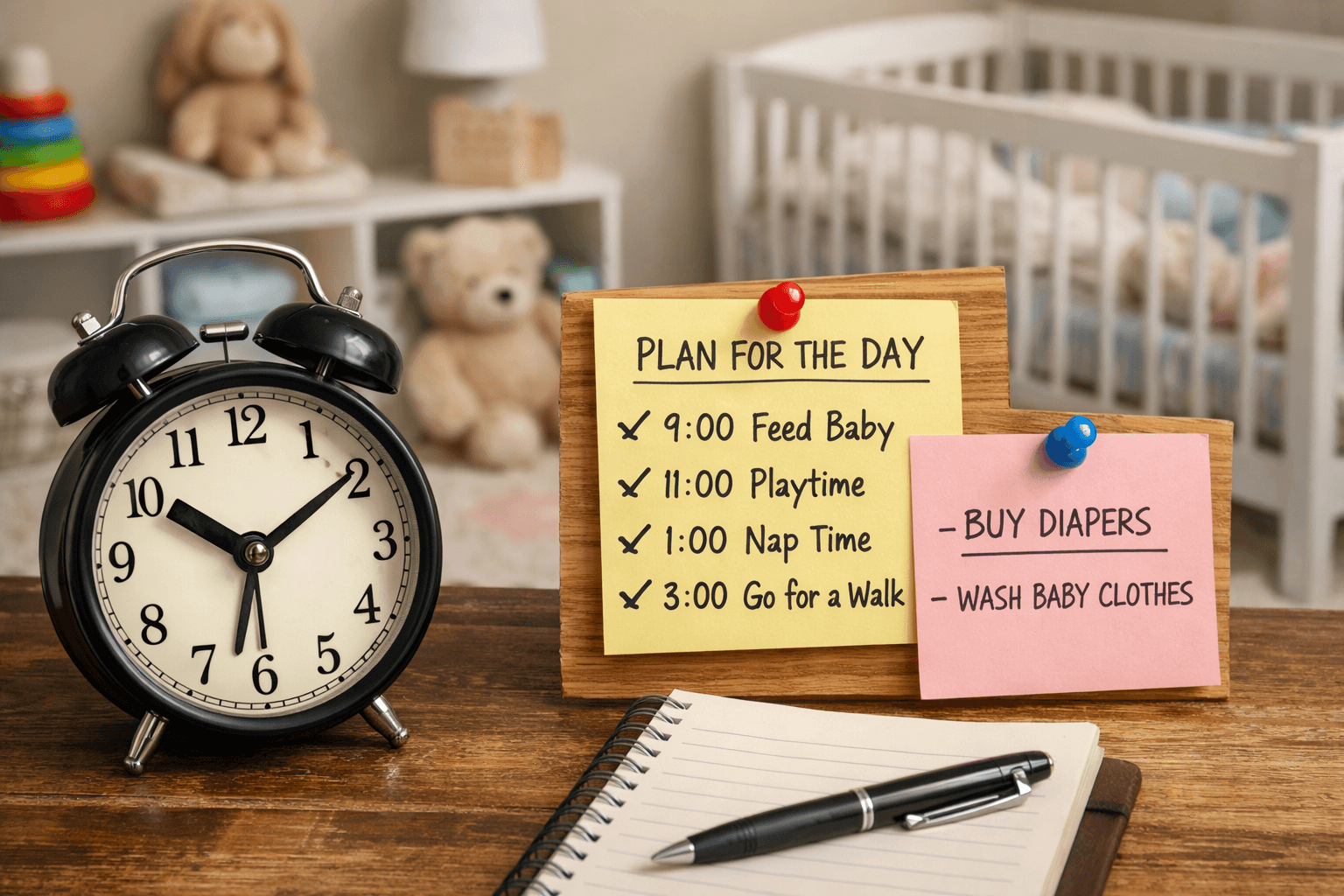
⚠️ This article is for educational purposes and doesn't replace medical advice. If you're worried about your baby, call your pediatrician or emergency services.
Eat‑Play‑Sleep Newborn Routine: A Simple 2–3 Hour Rhythm (0–12 Weeks)
At a glance
- Eat‑Play‑Sleep is a flexible order, not a strict schedule: feed after waking, a short calm “play,” then back to sleep.
- For many babies, daytime cycles land around every 2–3 hours, but cues matter more than the clock.
- If your baby falls asleep while eating, you’re not “doing it wrong.” Newborns often do.
- Safe sleep comes first: back to sleep, firm flat surface, no loose bedding, room‑share (not bed‑share).
- Any fever in a baby under 12 weeks needs prompt medical advice (and under 2 months is typically ER).
Quick answer
Eat‑Play‑Sleep is a simple way to structure the newborn day: feed when baby wakes, do a diaper and a few minutes of interaction, then help baby sleep again. It often repeats about every 2–3 hours in the daytime, but it should stay responsive to your baby—not rigid.
What “Eat‑Play‑Sleep” means for newborns (0–12 weeks)
Here’s the basic idea:
- Eat: Offer breast milk or formula soon after baby wakes.
- Play: A diaper change + a little connection (cuddles, talking, a song, a few minutes of tummy time).
- Sleep: Back to sleep in a safe sleep space.
Why “eat first” matters in the early weeks
Newborns have tiny stomachs and often need to eat frequently. Feeding early in the wake time can:
- help you catch hunger before baby is too upset to latch or settle
- make it easier to notice patterns (even if they change weekly)
Breastfed babies may eat as often as every 1–3 hours at times, especially early on, and many exclusively breastfed babies average every 2–4 hours as the weeks go on.
What “play” looks like at 0–12 weeks
“Play” doesn’t need toys or a long routine. It can be:
- a diaper change
- skin‑to‑skin, cuddles, talking
- looking at your face near a window
- supervised tummy time when baby is awake
If your baby seems overwhelmed quickly, that’s normal. Many newborns can only handle a small amount of stimulation before they need help winding down.
What’s normal vs. what’s not
What’s normal (and common)
- Waking to eat day and night. Many newborns wake every few hours.
- Cluster feeding (especially in the evening).
- Falling asleep while eating (very common in the first weeks).
- Short, unpredictable naps and day/night confusion early on.
What’s not normal (get advice)
Call your pediatrician promptly if you notice signs your baby may not be getting enough milk/formula, such as:
- very low wet diapers or a sudden drop in wet diapers
- persistent poor feeding, weak suck, or baby is very hard to wake for feeds
A general sign of adequate intake (once milk is in) can include around 6+ wet diapers/day (stool patterns vary). If you’re not seeing wet diapers or you’re worried, it’s worth calling.
What you can do now (step‑by‑step)
Step 1) Start the cycle when baby wakes: Eat
Offer a full feed soon after waking.
Helpful notes:
- In the early weeks, some babies need to be woken to feed—especially if there are weight‑gain concerns. Follow your baby’s clinician’s plan.
- If breastfeeding, frequent feeding can also support milk supply.
Step 2) Burp + diaper (as needed)
You can do diaper change:
- before the feed (to wake baby up a bit), or
- after the feed (to keep baby comfortable)
If baby is very sleepy at the breast/bottle, a diaper change mid‑feed can sometimes help them finish.
Step 3) “Play” = short, calm connection
Aim for a few minutes, not a big activity list. Try:
- 1–5 minutes of tummy time (awake + watched)
- a short walk around the house
- talking/singing softly
- looking at a high‑contrast book
If your baby gets fussy fast, “play” might simply be a diaper change and cuddles. That still counts.
Step 4) Wind down and go back to sleep (safe sleep every time)
Keep your wind‑down simple:
- dim lights
- swaddle if you use it and it’s still safe for your baby’s stage
- gentle rocking, shushing, or holding
Safe sleep basics (AAP-aligned):
- Put baby on their back for every sleep (naps and night).
- Use a firm, flat, non‑inclined sleep surface with only a fitted sheet.
- Keep blankets, pillows, bumpers, and toys out of the sleep space.
- Room‑share, don’t bed‑share (same room, separate sleep surface), ideally for at least 6 months.
Step 5) Help day/night confusion (gentle cues)
Many babies mix up days and nights at first. Two simple cues can help over time:
- Daytime: light, normal household sounds during awake time
- Night: dim, quiet, boring feeds/changes (no “playtime”)
It won’t flip overnight, but consistent cues can help baby’s rhythm mature.
Step 6) Troubleshoot when the cycle falls apart (because it will)
Common “Eat‑Play‑Sleep” hiccups and what to try:
-
Baby falls asleep during the feed
- Normal. Try gentle stimulation (tickle feet, diaper change, burp break), then continue feeding if they’ll take it.
-
Baby wants to eat again 30–60 minutes later
- Could be normal (cluster feeding, growth spurt). Offer the feed, then reset the cycle.
-
Baby won’t settle for sleep after “play”
- Try shortening playtime and starting wind‑down earlier next cycle.
- Check basics: hunger, burps/gas, too hot/cold, diaper, overstimulation.
What to avoid
- Avoid forcing a strict schedule in the first 12 weeks. Use the order more than the clock.
- Avoid trying to stretch feeds to “make baby sleep longer,” especially in the early weeks. Feeding frequency supports growth.
- Avoid unsafe sleep setups (adult beds, couches/armchairs, soft surfaces, loose blankets).
- Avoid routine sleep in sitting devices (car seats, swings, strollers) as a primary sleep plan - AAP warns against these for routine sleep, especially for young infants.
When to call the pediatrician / 911 (Red‑flags box)
Call 911 now if your baby:
- Has severe trouble breathing, stops breathing, passes out, or has bluish lips/face (not just being cold).
Go to the ER now / get urgent medical care if your baby is under 12 weeks and:
- Has any fever (100.4°F / 38°C or higher). Under 2 months: go to the ER immediately; 2–3 months: call your baby’s provider immediately.
- Seems very sick, is hard to wake, very floppy, or won’t feed.
Important: If your baby is under 3 months, many children’s hospitals advise not giving fever medicine before being seen unless your clinician tells you to.
Sample daytime rhythms (0–12 weeks)
These are examples, not rules. Your baby may cycle faster (especially during cluster feeding) or slower.
Example: “2–3 hour daytime loop” (most common starting point)
- Wake → Feed
- Diaper + 5–20 minutes calm interaction
- Back to sleep
- Repeat
Example day (around 6–12 weeks) — by-the-clock guide
- 7:00 am Feed
- 8:15 am Nap
- 9:30 am Feed
- 10:45 am Nap
- 12:00 pm Feed
- Afternoon: repeat similar loops
- Evening: expect more frequent feeding some days.
If you want a schedule, think: “the next feed is usually coming soon”—not “we must hit 9:30.”
FAQs
1) Is Eat‑Play‑Sleep okay if I’m breastfeeding?
Yes—as long as feeding stays first and responsive. Breastfed babies may feed frequently, including cluster feeding, and that can be normal.
2) What if my newborn falls asleep while eating?
That’s extremely common. You can try a diaper change or burp break to keep them awake, but it’s also okay if the order sometimes becomes Eat‑Sleep‑Play for a while.
3) Should I wake my baby to feed every 2–3 hours?
Sometimes. If your baby has weight‑gain concerns, your clinician may want waking for feeds. CDC notes some newborns can be sleepy and may need to be woken to feed early on. When in doubt, ask your baby’s doctor.
4) How long should “play” be for 0–12 weeks?
Often very short. If baby stays calm, you can do a few minutes of tummy time or face‑to‑face time. If baby gets fussy quickly, shorten it and start wind‑down sooner.
5) Can I do Eat‑Play‑Sleep at night?
At night, many families do Eat → quick diaper if needed → straight back to sleep (minimal talking, dim lights). That supports day/night learning and protects your sleep.

Ready to Start Your Journey?
Join thousands of parents who trust Cuddlydoo to help them navigate the beautiful chaos of parenthood. Start your free journey today.
Sources
- American Academy of Pediatrics – HealthyChildren.org, “How to Keep Your Sleeping Baby Safe: AAP Policy Explained” (Last Updated 1/8/2026).
https://healthychildren.org/English/ages-stages/baby/sleep/Pages/A-Parents-Guide-to-Safe-Sleep.aspx - American Academy of Pediatrics – HealthyChildren.org, “Safe Sleep: Back is Best, Avoid Soft Bedding, Inclined Surfaces & Bed Sharing” (Published 6/21/2022).
https://www.healthychildren.org/English/news/Pages/safe-sleep-back-is-best-avoid-soft-bedding-inclined-surfaces-and-bedsharing.aspx - American Academy of Pediatrics – HealthyChildren.org, “12 Ways to Reduce the Risk of SIDS & Suffocation” (Last Updated 1/12/2026).
https://www.healthychildren.org/English/ages-stages/baby/sleep/Pages/Preventing-SIDS.aspx - Centers for Disease Control and Prevention (CDC), “How Much and How Often to Breastfeed” (March 20, 2025).
https://www.cdc.gov/infant-toddler-nutrition/breastfeeding/how-much-and-how-often.html - Centers for Disease Control and Prevention (CDC), “Helping Babies Sleep Safely” (September 25, 2024).
https://www.cdc.gov/reproductive-health/features/babies-sleep.html - MedlinePlus (National Library of Medicine), “Feeding patterns and diet – babies and infants” (Review Date 7/1/2025).
https://medlineplus.gov/ency/patientinstructions/000712.htm - Children’s Hospital of Philadelphia (CHOP), “Fever in a Newborn.”
https://www.chop.edu/conditions-diseases/fever-newborn - Seattle Children’s, “Breathing Trouble” (Last Reviewed 05/06/2025).
https://www.seattlechildrens.org/conditions/a-z/breathing-trouble/ - St. Louis Children’s Hospital, “Fever (0–12 Months)” (Symptom Checker).
https://www.stlouischildrens.org/health-resources/symptom-checker/fever-0-12-months - Stanford Medicine Children’s Health, “Newborn Sleep Patterns.”
https://www.stanfordchildrens.org/en/topic/default?id=newborn-sleep-patterns-90-P02632 - NIH NICHD – Safe to Sleep®, “Ways to Reduce Baby’s Risk.”
https://safetosleep.nichd.nih.gov/reduce-risk/reduce